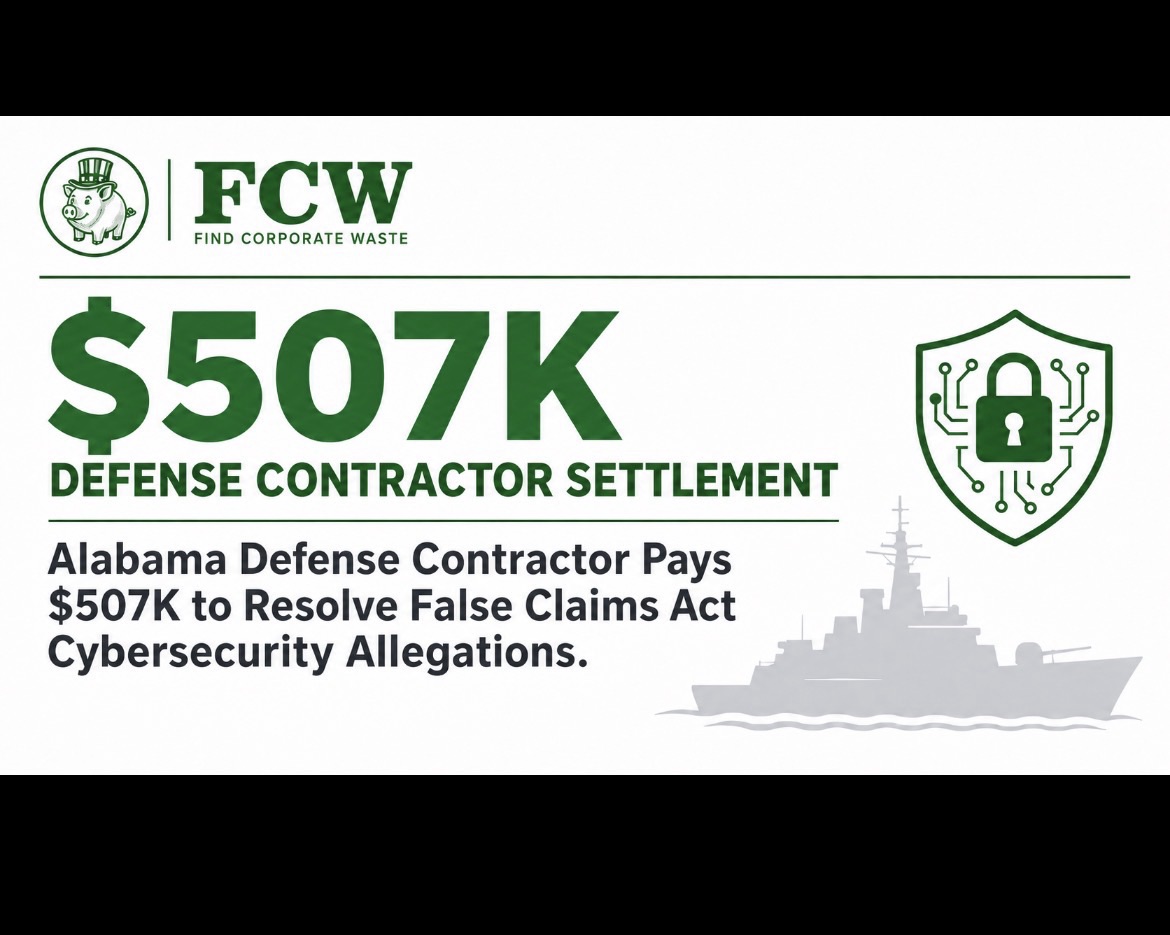
Tag: False Claims Act

  • Contractors to Pay $3.6M Over False Veteran-Owned Small Business Certification

    Contractors to Pay $3.6M Over False Veteran-Owned Small Business Certification

    Two government contractors agreed to pay more than $3.6 million to resolve allegations involving False Claims Act and Contract Disputes Act liability tied to federal set-aside contracts, according to the DOJ.

    The settlement involves Officium Global LLC and Loyal Source Government Services LLC. Prosecutors said Officium Global allegedly submitted false or fraudulent claims for payment on seven service-disabled veteran-owned small business set-aside contracts awarded between May 2017 and June 2018.

    According to the settlement agreement, Officium Global was allegedly not entitled to those contracts because its management and daily business operations were not controlled by a service-disabled veteran. The DOJ said the company submitted, or caused to be submitted, false certifications and statements representing that it met all requirements to be a service-disabled veteran-owned small business when it did not.

    Officium Global will pay more than $1.8 million to resolve the False Claims Act allegations. Loyal Source Government Services will separately pay more than $1.8 million to resolve Contract Disputes Act allegations tied to alleged breaches of the same seven contracts.

    The case began as a qui tam lawsuit filed by relator Jeremy Lavin in the Middle District of Florida. Under the False Claims Act, private citizens may sue on behalf of the United States and share in the recovery.

    The DOJ said Lavin will receive more than $680,000 from the settlement proceeds.

    The case is United States ex rel. Lavin v. Loyal Source Government Services, LLC et al., No. 6:19-cv-958, in the U.S. District Court for the Middle District of Florida. 

    Find Corporate Waste tracks False Claims Act recoveries involving government contracting fraud, small-business set-asides, and eligibility certifications. Anyone with inside knowledge of set-aside control failures, pass-through contracting arrangements, or false small-business certifications may have information relevant to public-fraud enforcement.

  • Delco Woman Pleads Guilty in $7.17M EIDL Fraud-Proceeds Laundering Scheme

    Delco Woman Pleads Guilty in $7.17M EIDL Fraud-Proceeds Laundering Scheme

    A Pennsylvania woman pleaded guilty in a money laundering conspiracy tied to more than $7.17 million in fraud proceeds, according to the U.S. Attorney’s Office for the Eastern District of Pennsylvania.

    Christina Williams, 31, of Drexel Hill, admitted to conspiring to launder fraud proceeds with her mother, Rosemarie Dixon, and others. The case was also highlighted by the SBA Office of Inspector General.

    Prosecutors said Williams Royal Real Estate LLC and Dixon Delish Kitchen LLC were sham businesses with no real operations or employees. Bank accounts opened in those names allegedly received proceeds from fraudulent Economic Injury Disaster Loan applications and business email compromise schemes.

    The government says the funds were quickly moved between business accounts, personal accounts, and other sham-business accounts controlled by participants in the conspiracy. Prosecutors placed the total amount laundered, attempted to be laundered, or agreed to be laundered at $7,171,730.

    Williams and Dixon are scheduled to be sentenced on September 9. Each faces up to 20 years in prison.

    For Find Corporate Waste, the case underscores a recurring pandemic-fraud lesson: the paper trail does not stop at the false application. It often runs through shell entities, bank accounts, insider permissions, and rapid money movement.

  • Oglethorpe Pays $32M Over Medicare Overpayment Allegations

    Oglethorpe Pays $32M Over Medicare Overpayment Allegations

    Oglethorpe Inc. and three top executives agreed to pay $32 million to resolve False Claims Act allegations tied to Medicare overpayments at behavioral health facilities.

    According to the DOJ, Oglethorpe, its founder Robert Cohen, CEO John Picciano, and COO James O’Shea allegedly failed to return overpayments that the company’s own consultants had identified.

    The alleged overpayments involved Medicare beneficiaries admitted to Ridgeview Behavioral Hospital, Georgetown Behavioral Hospital, and The Woods at Parkside, despite allegedly not qualifying for inpatient psychiatric care.

    The case stands out because Oglethorpe had already entered a 2021 Corporate Integrity Agreement after an earlier FCA settlement. Following alleged violations, the defendants agreed to a 10-year exclusion from Medicare, Medicaid, and all federal health care programs beginning in July 2026.

    The lawsuit was filed by four former Oglethorpe employees under the FCA’s whistleblower provisions. Their relator share has not yet been determined.

  • Georgia Man Gets 37 Months in $441K COVID Relief Fraud Case

    Georgia Man Gets 37 Months in $441K COVID Relief Fraud Case

    Brian Graham, 49, of Lithia Springs, Georgia, was sentenced to 37 months in federal prison after pleading guilty to wire fraud in a COVID-relief scheme involving the PPP and EIDL programs.

    According to the U.S. Attorney’s Office for the District of Colorado, Graham prepared and submitted fraudulent loan applications between April 2020 and August 2021 for several business entities he controlled. Prosecutors said the applications misstated employee counts, gross revenues, cost of goods sold, and payroll.

    The court ordered Graham to pay $441,546 in restitution, serve three years of supervised release, and forfeit proceeds tied to the offense. The SBA also highlighted the sentence.

    The critical allegation was not just bad paperwork. Graham certified that the information was accurate and that the funds would be used for payroll and other approved business expenses. Prosecutors said he instead used the bulk of the money for himself.

    The case, United States v. Graham, 1:25-cr-00079-JLK, was investigated by TIGTA and the SBA Office of Inspector General.

    Brian Graham allegedly used his role as a notary to defraud the American taxpayer.

    For Find Corporate Waste, the Graham case is a reminder that pandemic fraud often hides in plain sight: controlled entities, inflated numbers, false certifications, and taxpayer-backed money converted into personal gain.

  • Brooklyn Clinic Owner Convicted in $52M Health Care Fraud and Kickback Scheme

    Brooklyn Clinic Owner Convicted in $52M Health Care Fraud and Kickback Scheme

    A federal jury in the Eastern District of New York convicted Tony Brown-Arkah, 78, owner of American Medical Centers, a Brooklyn clinic that purported to provide substance abuse treatment, for his role in a $52 million health care fraud, narcotics, and kickback scheme.

    According to the Department of Justice, Brown-Arkah’s clinic illegally prescribed Suboxone, a Schedule III narcotic used to treat opioid use disorder, while allowing drug diversion activity to operate around the clinic. Witnesses testified that patients were directed to sell prescriptions outside the facility, including to a van near the clinic.

    The DOJ said many patients received prescriptions signed by a nurse practitioner in Florida who did not see or speak with them. Patients were also subjected to medically unnecessary testing, while Medicare and Medicaid were billed for services that were not provided or not legitimate.

    Brown-Arkah was also convicted of paying patient kickbacks and receiving laboratory kickbacks tied to unnecessary testing referrals. Prosecutors said he used a shell company and sham contract to conceal the payments.

    The case reflects the DOJ’s continued focus on health care fraud involving addiction treatment, laboratory testing, controlled substances, and federal program billing.

    DOJ Press Release — Clinic Owner Convicted for $52M Health Care Fraud, Illegal Narcotics Distribution, and Kickback Scheme

    DOJ Health Care Fraud Unit

    Find Corporate Waste — False Claims Act

  • VSoft to Pay Nearly $2.3M Over PPP Eligibility Allegations

    VSoft to Pay Nearly $2.3M Over PPP Eligibility Allegations

    VSoft Corporation has agreed to pay $2,291,927.07 to resolve False Claims Act allegations that it improperly obtained a second-draw Paycheck Protection Program loan.

    According to the DOJ, VSoft, an Atlanta-based banking and payment solutions provider, allegedly certified that it qualified as a small business with fewer than 300 employees when applying for a $1,259,732 PPP loan. Prosecutors alleged that VSoft was actually part of an international corporate structure with multiple locations worldwide and employee totals well above the second-draw PPP limit.

    This is exactly the kind of case Find Corporate Waste was built to track: follow the money, stop the fraud, and protect taxpayer dollars. Pandemic relief was designed to keep legitimate small businesses alive, not to subsidize companies that allegedly avoided size and affiliation rules.

    The case began as a whistleblower action under the False Claims Act: United States ex rel. GHGH2, Inc. v. Vsoft Technologies Corporation, Case No. 3:24-cv-999 (W.D.N.C.).

    The settlement resolves allegations only, with no determination of liability. But the message is clear: insiders, competitors, lenders, and data reviewers remain essential to exposing improper relief claims and helping recover public funds.

  • Regions Bank to Pay $4.9M Over Ineligible PPP Forgiveness Approval

    Regions Bank to Pay $4.9M Over Ineligible PPP Forgiveness Approval

    Regions Bank has agreed to pay the United States $4.9 million to resolve civil allegations connected to a Paycheck Protection Program loan forgiveness approval that the government says should not have been granted.

    According to the DOJ, the matter involved a PPP loan obtained by Gregory A. DeLine, who owned or operated several businesses, including Midwest Mortgage Associates Corporation d/b/a Total Lending Concepts, Amega Sales Inc., and GKD Management, L.P.

    The government alleged that Regions approved full forgiveness of the loan even though the loan was not eligible for forgiveness.

    The public settlement documents do not identify the exact defect that made the loan ineligible. That distinction matters. The case should not be overstated as a public finding that the borrower committed fraud or that Regions admitted wrongdoing.

    The DOJ framed the civil resolution against Regions under an unjust enrichment theory, meaning the government alleged Regions received money it should not have received after approving forgiveness.

    The Paycheck Protection Plan (PPP) was created under the CARES Act to provide emergency relief during the COVID-19 pandemic. Borrowers could seek forgiveness if funds were used for payroll and other approved expenses. Once forgiveness was approved, the SBA paid the lender the forgiven principal and interest.

    For Find Corporate Waste, this case highlights why public-data review must examine the full structure of relief programs: borrower eligibility, certifications, lender review, forgiveness approval, and federal reimbursement. A single improper forgiveness approval can create millions in taxpayer exposure.

    Public records can identify the pattern, but insider knowledge transform that pattern into an actionable lead potentially worth millions.

  • Minnesota Medicaid Fraud Takedown Charges 15 Defendants in Alleged $90M Scheme

    Minnesota Medicaid Fraud Takedown Charges 15 Defendants in Alleged $90M Scheme

    The DOJ announced a major Minnesota health care fraud takedown on May 21, 2026, charging 15 defendants in alleged schemes involving more than $90 million in intended loss.

    The charges target owners of child care centers, autism-service providers, housing-support operators, and other Medicaid-linked providers accused of exploiting public programs designed for vulnerable children, disabled adults, seniors, and low-income families.

    According to the DOJ, the largest case involves Minnesota’s Early Intensive Developmental and Behavioral Intervention program, known as EIDBI, which provides services for people under 21 with autism spectrum disorder.

    Two defendants were charged in connection with an alleged $46.6 million scheme involving kickbacks to parents, medically unnecessary autism diagnoses, and billing for autism services that were not actually provided.

    The growth of the program is staggering. The DOJ said EIDBI claims rose from more than $600,000 in 2018 to more than $400 million by 2025. That kind of explosion is exactly why health care fraud enforcement increasingly depends on data analytics, billing-pattern review, and cross-agency scrutiny.

    The takedown also includes first-of-their-kind criminal prosecutions involving Minnesota’s Integrated Community Supports and Individualized Home Supports programs. In the ICS case, prosecutors allege a defendant billed Medicaid for services that were not provided as represented, including for a vulnerable recipient who required 24-hour care and was later found deceased. In the IHS case, two defendants allegedly concealed financial interests in more than 20 residences while billing Medicaid for services tied to adults with disabilities.

    The DOJ also charged eight defendants in alleged Housing Stabilization Services fraud totaling approximately $15.7 million. That program was created to help people with disabilities, seniors, and people with mental health or substance-use disorders find and maintain housing. But prosecutors said low barriers to entry and minimal documentation requirements made the program vulnerable to fraud. Minnesota eventually shuttered the program on October 31, 2025, after fraud concerns overwhelmed its integrity.

    This announcement is not just about Minnesota. The DOJ also announced funding for 15 new Trial Attorney positions to expand Medicaid fraud enforcement nationwide. The department said these prosecutors will support existing strike forces in states including California, Florida, New York, and Texas, while also expanding rapid-response enforcement across the country.

    For Find Corporate Waste, the message is clear: Medicaid fraud is not a paperwork problem. It is a taxpayer-integrity problem. These programs exist to serve people with serious needs, but weak controls, loose provider entry standards, shell-provider structures, and explosive billing growth can turn public benefits into private revenue machines.

    The DOJ also emphasized that its Health Care Fraud Section’s Data Fusion Center used advanced data analytics to identify and support the Minnesota cases. That matters. Public records, provider data, corporate filings, exclusion lists, addresses, ownership patterns, billing spikes, and program-growth anomalies can reveal serious fraud signals long before a prosecution is announced.

    This is the kind of enforcement environment where public-interest data mining matters. Find Corporate Waste tracks fraud, waste, abuse, and False Claims Act enforcement because taxpayers deserve to know how public money is being spent, who is exploiting weak oversight, and our country will not survive the looting of our government for personal gain.

  • Canadian Steel Companies to Pay $19M Over False Claims Act Trade Fraud Allegations

    Canadian Steel Companies to Pay $19M Over False Claims Act Trade Fraud Allegations

    Two Canada-based steel companies and their owner have agreed to pay $19 million to resolve False Claims Act allegations involving evaded customs duties on imported steel.

    According to the DOJ, Farjess Inc., Royal Canadian Steel Inc., and part-owner and president Feroz Jessani allegedly failed to pay duties owed on flat-rolled steel manufactured in Europe and Asia.

    Federal officials said the companies represented that certain steel originated in Canada or the United States, when they allegedly knew the steel actually came from China, Indonesia, Italy, Turkey, or Vietnam.

    The alleged conduct occurred from May 2019 through January 2025.

    This case matters because trade fraud is not just a customs issue. It is a taxpayer issue, a market fairness issue, and a direct threat to American businesses that follow the rules.

    Importers are required to accurately declare the country of origin, value, duty status, and amount of duties owed when goods enter the United States. When those declarations are false, the government can lose revenue while competitors gain an unfair advantage.

    That is exactly why the False Claims Act remains one of the government’s strongest tools against corporate fraud.

    The statute allows the government to recover funds when false statements or fraudulent conduct cause financial harm to the United States.

    It also allows whistleblowers to bring cases on behalf of the government and share in any recovery.

    The whistleblower in this case was Shamsh Dhala, a broker who worked with Farjess Inc.

    Dhala filed the case under the qui tam provisions of the False Claims Act in the Eastern District of Michigan.

    The case is captioned United States ex rel. Dhala v. Royal Canadian Steel Inc. et al., No. 2:23-cv-12097.

    As part of the settlement, Dhala will receive approximately $3.61 million.

    For Find Corporate Waste, the message is clear: corporate fraud often hides in ordinary paperwork. A customs form, shipment record, invoice, certification, billing file, or loan application can become the starting point for a major federal recovery.

    This settlement also fits into a broader enforcement pattern. The DOJ said the case was coordinated through its Trade Fraud Task Force, a cross-agency effort focused on tariff evasion, customs fraud, prohibited imports, threats to domestic industry, and conduct that weakens national security.

    The same logic applies across the areas covered by Find Corporate Waste: False Claims Act cases, government contracting abuse, pandemic relief fraud, healthcare fraud, customs fraud, and other schemes involving public money.

    When companies cheat the system, the cost does not disappear. It is shifted onto taxpayers, lawful competitors, American workers, and the public.

    If you have information about customs fraud, government contract abuse, healthcare billing fraud, pandemic relief misuse, or other misuse of taxpayer funds, Find Corporate Waste wants to hear from you.

    The strongest cases often begin with a person willing to connect the dots.

  • California Doctor Convicted in $45M Botox Medicare Fraud Scheme

    California Doctor Convicted in $45M Botox Medicare Fraud Scheme

    A federal jury in the Central District of California convicted Dr. Violetta Mailyan, 45, of Glendale, California, for her role in a $45 million Medicare fraud scheme built around Botox billing. According to the DOJ, Mailyan submitted claims for Botox injections that were either never provided, medically unnecessary, cosmetic in nature, or unsupported by the medical records required for Medicare reimbursement. 

    The DOJ said the investigation began after the Health Care Fraud Section’s Data Analytics Team flagged Mailyan as an extreme Medicare outlier: she had been paid more for Botox injections than any other doctor in the country.

    At one point, she had received more than $24 million over four years, roughly six times more than the next highest comparison group, all of whom were neurologists.  

    The details are staggering. Prosecutors said Mailyan billed Medicare for Botox treatments while she was vacationing in Cabo, Maui, Las Vegas, Pennsylvania, and New York. She also allegedly billed for a Medicare beneficiary who was incarcerated in federal prison and submitted over $19 million in claims for injections supposedly performed on days when her clinic was closed.  

    According to trial evidence, Mailyan backdated claims, fabricated patient consent forms, altered medical records after receiving a grand jury subpoena, and tried to make it appear that patients suffered from chronic migraines requiring treatment. The jury convicted her of nine counts of wire fraud and three counts of obstruction. Sentencing is scheduled for September 10, 2026

    The forfeiture findings tell the rest of the story: a Tesla Model X, a Tesla Cybertruck, more than $251,000 in bank funds, brokerage accounts valued at over $7.3 million, and four California properties with estimated equity above $7.3 million were found subject to forfeiture as fraud proceeds. 

    This case shows that investigators must follow abnormal billing patterns, outlier providers, ownership trails, and public data signals before the money disappears.

    The DOJ’s new Fraud Division and Health Care Fraud Strike Force are now openly leaning into analytics, and that shift matters. Find Corporate Waste exists to follow that trail.

    If you have information about government funds being misused, inflated, concealed, or routed through questionable claims, now is the time to come forward.